Wednesday, August 15, 2012

The History of Tattoos

The History of Tattoos Primitive Tattoos Skin was the first canvas for art. Sticks and other pointy objects were the first paintbrushes. Tattooing was first a form of scarification. This involved wounding oneself and packing dirt or ashes into the scrape or cut to discolor it permanently. It is believed that prehistoric man cut holes in his skin, charred sticks in the fire, let them cool and then applied the black substance to the wound to create tribal markings. As tattooing involved pain, blood and fire, primitive man believed the process released sacred life forces. The letting of blood was also associated with a sacrifice to the Gods. The symbol or animal form of the tattoo was thought to bring one protection from attack from that very same animal. Tattoos were also used to bring one's soul in alignment with God's purpose, increase virility and fertility, ensure the preservation of the body after the death and delineate hierarchies and roles within tribes. For instance, a tribal chieftain would have a very different tattoo than the individual in the tribe who was thought to bring them all bad luck. As skin does not preserve that well there is very archeological evidence that prehistoric people engaged in tattooing, although a few Paleolithic artifacts that have been discovered seem to suggest that the art of tattooing is as old as mankind. Funereal Art Tattooing in ancient history was a funereal art. Images of tattooing are found on Egyptian female figurines that are dated between 4000 and 2000 years BC. Libyan figures from the tomb of Seti (1330 B.C.) also boast figures with tattoo markings on the arms and the legs. Both in ancient and modern times, primitive people believe that the spirit or astral body resembles an invisible human body. This is similar to many modern occultist beliefs about the astral body. Tattoos are applied so that the spirit is allowed to pass into the spirit world undisturbed by evil entities. The primitive peoples of Borneo believe that the right tattoo ensures prompt passage to the other side as well as a guaranteed positive occupation in the spirit world. The ancient Egyptians reportedly spread the practice of tattooing throughout the world. The pyramid-building third and fourth dynasties of Egypt developed international nations that ruled Crete, Greece, Persia, and Arabia. By 2000 B.C. the art of tattooing had found its way to Southeast Asia and the Ainu (western Asian nomads) then brought it with them on their migrations to Japan. Elsewhere, the Shans of China introduced the craft to the Burmese, who still include tattooing as part of their religious practices. Today, tattoos are still used to create a spirit connection with deceased loved one and family members. These types of tattoos are rarer, but they often appear as hearts with initials, tombstones with parent's initials and heavenly symbols such as five, six and seven pointed stars. Branding Around the same time, the Japanese became interested in the art but only for its decorative attributes. The Horis -- the Japanese tattoo artists --- were the undisputed ancient masters of the color tattoo. Their use of pigments, perspective, and imaginative designs gave the practice a whole new appearance. During the first millennium A.D., Japan adopted Chinese culture and confined tattooing to branding wrongdoers. In the Balkans, the Thracians had a different use for the craft. Aristocrats, according to Herodotus (500 B.C.) were tattooed to show the world their social status. Although early Europeans dabbled with tattooing, they truly rediscovered the art form when they explored new cultures in the South Pacific. It was a familiarity with the tattoos of Polynesian and American Indian tribes that introduced tattoos to the modern Europe. The word, in fact, is derived from the Tahitian word tattau, which means, "to mark." Most of the early uses of tattoos were ornamental. However, a number of civilizations had practical applications for this craft. The Goths, a tribe of Germanic barbarians famous for pillaging Roman settlements, used tattoos to brand their slaves. Romans also tattooed slaves and criminals. Tattooing was first associated with criminality in the Mediterranean region in the middle of the third century. These labels would include the crime, the punishment and the names of the criminal's victims branded on their foreheads. In ancient Greece and Rome, slaves with tattoos could never become citizens, even if they were able to buy their freedom. This was because a tattoo was seen as degrading to the bearer. In essence, the tattoos were permanent marks of guilt. Eventually those tattooed out of punishment started to be proud of their markings. Tattoos are still a mark of honor among criminals today. In Tahiti, tattoos were a rite of passage and told the history of the person's life. Men were marked when they reached adulthood when they got married. When the Turkish Ottoman Empire ruled Bosnia, military authorities tattooed all of the soldiers in order to recognize them in case they chose to flee conscription. Clan Markings Primitive peoples also used tattoos to create what are called clan markings. These marking came in handy during battle to identify foe from friend. These tattoos also guaranteed that you would be able to greet your friends again in heaven, after you had passed away. Family and marriage tattoos were also clan markings that enabled spouses who were separated in death to find each other again in the afterworld. A good example of this is the ancient Ainu tribe who believed that a bride without a tattoo would go straight to Gehenna - their version of hell. In the Americas, native tribes used simple pricking to tattoo their bodies or faces. In California some native groups injected color into the scratches. Some northern tribes living in and around the Arctic Circle (mostly Inuit) made punctures with a needle and ran a thread coated with soot through the skin. The South Pacific community would tap pigment into the pricked skin using a small rake-like instrument. In New Zealand, the Maori would treat the body like a piece of wood in order to make their world-famous moko style tattoos. Using a small bone-cutting tool, they would carve intricate shallow grooves on the face and buttocks, and infuse them with color. Thanks to trading with Europeans, they were able to make the method more efficient by using metal tools instead of bone. A "moko", meaning to strike or tap, is the long-standing art form of Maori tattooing. This art form has been practiced for over a thousand years, and has withstood time and colonization. It was used as a form of identification with regards to rank, genealogy, tribal history, eligibility to marry, beauty and virility. Moko designs were finely chiseled into the skin. Maori women were traditionally only allowed to be tattooed on their lips, around the chin, and sometimes the nostrils. A woman with full blue lips was seen as very beautiful. Rites of Passage Primitive people also tattooed their adolescents as a rite of passage. The theory was that if a young boy couldn't take the pain of a tattoo at a young age, then he would be useless at battle. Similarly, if a young girl couldn't handle the pain of a tattoo, she would not be able to handle the pain of childbirth. Many of these children ended up with a tattoo anyway, that would label them as an outcast of the tribe. Totem animals are also another common motif in primitive tattoos. Totem animals such as snakes, frogs, butterflies wolves or bears signified that the individual has taken on the physical prowess of that animal. In some cultures, the totem animal is thought to have a special spiritual relationship with the bearer of tattoo and acts as a spirit guide. From the South Pacific to the South America, primitive people have customs involved with their tattooing rituals. Usually the person being tattooed is separated from others, smudged, isolated from the opposite sex or fed a special diet. From primitive times to now, Hawaiians celebrate specific tattoo gods. The designs associated with each God are locked away in the temples and priests conduct tattooing. Each tattooing session begins with a prayer to tattoo gods that implores that the operation goes well and that the designs be gorgeous in the end. Love Charms In the ancient and primitive worlds, tattoos were also used as love charms. Often the dye used for these types of tattoos was concocted from magical ingredients. For instance, the dye for an ancient Burmese love charm is made from a recipe that consists of a bright purple pigment called vermilion and the skins of a trout and a spotted lizard. This tattoo was usually a small triangle created by three dots and was concealed by clothing so that others could not identify it. Nowadays the equivalents of magic love tattoos are Celtic knots, hearts, cherubs, the Venus symbol and love goddesses. Physical Health In ancient Asian cultures, tattoos were often applied to ensure long term physical health. The Tibetans equated designs called mantra wheels with many minutes of chanting. These designs were tattooed on chakra (energy points) on the body to help the bearer of the tattoo achieve physical, emotional and spiritual harmony. Sometimes tattoos were created from medicinal dyes and marked on acupuncture points of the body in an attempt to cure chronic health problems and diseases. In quite a few cultures an image of a God or Goddess could also be tattooed on an acupuncture point or an afflicted part of the body in an attempt to heal it. In India, the Monkey God, Hanuman, was tattooed on dislocated shoulders. Older Maori women tattooed their lips and face to prevent failing vision. Ainu women tattooed a Goddess on their skin so that the evil spirits that bestowed disease would mistake them for the Goddess and flee in terror. Good Luck Historically tattoos have always been thought to bring the wearer good luck. In China, tattooing one's animal astrological symbol, such as The Pig or The Horse is thought to bring good fortune. Images of Koi, carp or goldfish were thought to bring prosperity and wealth to the bearer. In Burma, a parrot tattooed on the shoulder is thought to bring luck. In Thailand, a scroll representing Buddha in the posture of meditation is said to charm Lady Luck. Card tattoos such as the Ace of Spades and the Ten of Diamonds were worn by American soldiers in Vietnam to protect against bad luck and venereal disease. Celtic Tattoos In the 1970s, the counter culture in America rediscovered the beauty of primitive and tribal taboos. The most copied designs are primarily from Borneo, Japan, and the islands of the South Pacific. In the 1980's, Celtic tattoos became very popular, probably as a result of the popularity of Wiccan and pagan religions among young people. Most modern Celtic designs are sourced from ancient scrolls called the Irish Illuminated Manuscripts, which were created during the sixth and seventh centuries. As before that the Celts did not keep written records, designs are also found in ancient stone and metal work. Before the sixth century, these ancient peoples often tattooed or painted their faces and bodies to protect them from evil spirits and ensure victory in battle. The knotwork tradition of tattooing that was derived from Celtic manuscripts spread from Britain and Ireland to Scotland. Viking invaders eventually appropriated many of the Celtic designs into their own culture, often adding totem animals into the interlacing designs. Celtic knots are "zoomorphic" meaning that each strand of the design connects or spirals into another strand. Often these designs will graphically terminate in images of the feet, heads and tails of animals and other natural symbols. These animals were emblematic of different Celtic tribes and nationalities. Roman documents also indicate that ancient British and Scottish peoples may have tattooed themselves before entering into battle. Ancient stones from Gaul also show leaders with tattooed faces. These tattoos were created from woad, a plant that produces blue dye. A body of a Pict found frozen in the permafrost in Siberia indicated that these pre-Celtic peoples tattooed using puncture marks to create the forms and outlines of animals using woad as the dye. The Romans often employed Celtic tutors for their children. Many of these tutors were Druid priests. An ancient Roman recipe for tattoo ink, courtesy of the long deceased Roman physician Aetius 1 lb. of Egyptian pine wood bark 2 ounces of corroded bronze, ground with vinegar 2 ounces of gall (insect egg deposits) 1 oz. of vitriol (iron sulphate) Mix well and sift. Soak powder in 2 parts water and 1 part leek juice. Wash the skin to be tattooed with leek juice. Prick design with needles until blood is drawn. Rub in the ink. Pilgrim Tattoos The rise of the Christian and Islamic religions brought a halt to tattooing in the Europe in the Middle East. In the Old Testament of the Bible, the book of Leviticus states, "Ye shall not make any cuttings in your flesh for the dead, nor print any marks upon you: I am the Lord." This crede against tattooing caused the practice to disappear for about two thousand years as both the Christians and the Moslems revere the Old Testament. Still despite the widespread popularity of this religious belief, pilgrims in the Middle Ages still got tattoos once they reached the Holy Land to prove to the folks back home that they had actually made the journey. The Coptic priests who sat outside the walls of Jerusalem waiting for tourists practiced this kind of tattooing. Usually these tattoos were just a simple cross, but some pilgrims opted for more elaborate symbols of their trip such as images of the Pieta or St. George slaying the Dragon. Moslem pilgrims visiting Mecca and Medina also returned from their trips boasting commemorative tattoos. These Moslem pilgrims believed that, by being cremated at death, they would be purified by fire, before entering paradise and thus are forgiven for transgressing Levictus's proclamation. Oriental Tattoos In Japan, tattooing reached its height in the 18th century images from traditional watercolor paintings; woodcuts and picture books were the basis of the design. Japanese tattoo artists were usually also ukiyoe woodblock artists, who simply exchanged their wood-carving blades for long, sharp needles. This long process has come to produce what is known as the uniquely-Japanese traditional art tattoo art form, called horimono. Sailor and Military Tattoos When European explorers first arrived in the New World, they discovered that tattooing was a large part of the stone-age culture practiced by Native Americans. Common among most tribes were geometric patterns and dots that were applied to celebrate the individual's passage into puberty. Many tribes, including the Sioux Indians believed that a tatoo was necessary in order to gain passage into the other world. After an almost two thousand year absence from popular culture, the phenomena of tattooing re-emerged after explorers brought tales of it home after they had sighted examples of it in the North and South Americas. Tattooing was also very popular among sailors who, from the 1600's to the 1940's tattooed a chicken on one foot and a pig on the other to protect them from death by drowning. During World War II, the big symbol that protected sailors from drowning were twin propellers (one tattooed on each buttock) meant to symbolically propel you to the shore. Images of bluebirds inked on the chest were often used to mark the number of miles a sailor had spent a sea. Each bluebird represented 5,000 miles logged at sea. If a sailor had sailed south past the equator he sometimes got a picture of Neptune tattooed n his leg. If he crossed the international dateline, a sailor owned the right to wear a tattoo of a dragon. A hula girl tattoo meant the sailor had been to Honolulu. Female underwear and stockings tattooed on the sailor's body meant that he had been on more than one cruise. Chatham Square in New York City became the epic-center for tattoos in pre-civil war days in the United States. Sailors, gang members and low-lifes (who often boasted elaborate tattoos on their torsos and forearms) frequented this area known for its beer halls and sex parlors. Sailors passed the long hours at sea "pricking" designs into their own skin or that of their mates. These designs were a mix of patriotic and protective images. Often gunpowder was mixed into the ink, as gunpowder was though to possess magical powers of longevity and protection. The seamen of that day were familiar with tattoos because of their extensive travel. They had seen the dragons of the China, the Christian charms and evil eyes of the people and the highly detailed designs of Edo and Yokohama worn by the citizens of Japan. Sailors bearing these exotic designs, passed through the port of New York everyday, greatly influencing and broadening the very concept of "tattoo" itself. With the outbreak of the Civil War, thousands of men from New York were conscripted into the Union Army. The demand for patriotic designs grew tremendously during that war and thousands of individuals were tattooed on the battlefield. Favorite designs often included depictions of major battles complete with sky and landscape. Electronic Tattoo Machines Tattooing was revolutionized by Samuel O'Reilly's invention of the electric tattoo machine during the last decade of the 19th century. The time required to complete a design went from hours to minutes, moving the art away from personally conceived, hand picked designs towards stock choices that were displayed like art on the walls of the tattoo parlor. Much of this tattooing was also conducted in the back of beer halls and barbershops. The years ahead would see vast improvements in O'Reilly's machine, plus the establishment of tattoo equipment manufacturing companies. This machine was the prototype for the tattoo gun that is the standard of the industry today. In the 1920's and 30's the styling of tattoos adapted to include comic strip characters like Mickey Mouse and Felix the Cat, Lindbergh's crossing, stars and starlets of the silver screen and phrases that were popularized in the press. Cosmetic tattooing also originated during this time period. Many artists offering specialties such as moles and beauty marks rosy cheeks, permanent eyeliner and red lips to both male and female customers. Modern Tattoos In the 1960s tattooing for art's sake alone became popular and nowadays the sight of a tattoo on someone's shoulder, hip or ankle has become commonplace. In recent years Celtic Tattoos have enjoyed a revival, as have primitive tattoos. Some people collect tattoos the way others collect antiques or works of art. Others are interested in the super sleek designs that are a product of the thinking of the 21st century such as biomechanical designs (which look like muscles beneath the flesh) and designs that resemble the interior workings of cyborgs. In the 1970s, artists trained in traditional fine art disciplines began to embrace tattooing and brought innovative imagery and drawing techniques to the industry. Advances in electric needle guns and pigments provided them with new ranges of color, delicacy of detail and artistic possibilities. The physical nature of many local tattooing establishments also changed as increasing numbers of operators adopted equipment and procedures resembling those of medical clinics -- particularly in areas where tattooing is regulated by government health regulations. The cultural status of tattooing has steadily evolved from that of an anti-social activity in the 1940s to that of a trendy fashion statement in the year 200s. First adopted and flaunted by influential rock stars like the Rolling Stones in the early 1970s, tattooing had, by the late 1980s, become accepted by mainstream society. Today, tattoos are routinely seen on rock stars, professional sports figures, ice skating champions, fashion models, movie stars and other public figures who play a significant role in setting the pace of contemporary culture. During the last fifteen years, two distinct classes of tattoo business have emerged. The first is the "tattoo parlor" that glories in a sense of urban outlaw culture, advertises itself with garish exterior signage and offers less than sanitary surroundings. The second is the "tattoo art studio" that most frequently features custom and fine art designs, all of the features of a high end beauty and "by-appointment" services only. Today's fine art tattoo studio draws the same kind of clients as a jewelry store, fashion boutique, or highend antique shop. Tattooing today is the sixth-fastest-growing retail business in the United States. The single fastest growing demographic group seeking tattoo services is middle-class suburban women. Tattooing is recognized by government agencies as both an art form and a profession. As tattoo-related artwork is considered to be fine art, tattoo designs are the subject of museum and gallery art shows across the United States, Canada and Europe. Nowadays everything from Andy Warhol portraits to Teletubbies to instant messenger smiley face icons just about any image is fair game for a tattoo. Your choice of a tattoo design is only as limited as the reaches of your imagination! http://www.thetattoocollection.com/history_of_tattoos.htm

Traditional Chinese Medicine and Healing Powers

Traditional Chinese Medicine and Healing Powers What is Traditional Chinese Medicine? Traditional Chinese Medicine (TCM) is a system of healing from China. While TCM is regarded as an alternative medicine system in the West, in China and other Asian countries, it is practiced widely by the locals. Medical practitioners are trained in the diagnostic and healing techniques with centuries of tradition and philosophy. Like naturopathy, TCM is holistic. It considers all aspects of the person including physical, nutritional, emotional, mental and spiritual for diagnosis. TCM is based on the balance of opposing elements (the yin and yang) in the body, as well as their harmony with the environment around it. The two main forces of yin and yang combine to form the "qi" (pronounced as "chee") or universal life force. When qi is in harmony, health is not only enhanced but also the capacity for fufilment, happiness and well being. Disease and illness arise from imbalances of yin and yang that block the proper flow of qi. Therapies to treat disease are aimed at restoring the balance and unblocking the flow to restore health. TCM is primarily non-invasive. TCM treatments include the use of Chinese herbs, acupuncture, meditation, Chinese massage therapy, mental and physical disciplines such as Tai Chi and Qigong and nutritional therapy. Practitioners will attempt to realign the body's balance using a combination of treatments before suggesting surgery by a Western Doctor. Most research into the effectiveness of TCM has been conducted on acupuncture. Although it has been difficult to conclusively prove the benefits of acupuncture, the results of large-scale studies are sufficiently convincing enough for FDA to consider the tradition "promising" and worthy of further study. In addition, it has been proven that many herbs used in Chinese medicine have therapeutic benefits. For instance, ginseng and Echinacea are both powerful herbs with strong medicinal actions. More recently, there has been some acknowledgment that Chinese massage therapies do help to manipulate muscles, nerves and tendons. There are many criticisms of TCM as a form of healing. Most TCM methodologies have no research basis and remain largely unproven. Also, some of the TCM beliefs have been mixed with Eastern mythology. For instance, tiger penis is used as an energy supplement as tigers are considered energetic animals. Whether it really helps to boost energy levels remain unsubstantiated by proper research. Most of the Chinese herbs are also not regulated. This makes it more important to consult with a reputable and reliable TCM practitioner. However, aside from the criticisms, there is much merit in the philosophy of TCM. healing. If more research can be done into TCM, then the mythology can be separated from the facts and perhaps, more people will embrace TCM more readily as a form of healing. Chinese Herbal Medicine Of our earliest ancestors, the Chinese have made it a point to incorporate nature’s garden into the world of medicine more than any other culture, still adhering to the mindset of the importance of Chinese herbal remedies to this day. Although many cultures have traditionally used seeds and plant parts in their remedies, China has alleviated ailments using herbs since around 5,000 BC. Having amassed this knowledge for thousands of years, the Chinese have mastered the art of cultivating herbs for medicinal purposes and other cultures look to them for insight into how a diagnosis can be treated through the use of herbs. Traditional Chinese Medicine (TCM) is heavily relied on throughout the world by everyone from the common consumer to specialists in every field of medicine. The Chinese developed their system of medicine and herbal remedies to cater to the yin and yang principle, where the body should be in perfect balance and herbs deliver harmony to the person taking them. Instead of treating one symptom, as is commonly done in the Western world of modern medicine, Chinese herbal remedies seek to get the body back into a natural state of balance so that healing can occur and any imbalances are eliminated. In conjunction with herbs, the Chinese also incorporate acupuncture, massage, and a healthy diet into the concept of harmony for healing purposes. One Chinese Emperor is credited with the launch of Traditional Chinese Medicine. Emperor Shen Nong (2697 BC) began personally tasting and testing various plants and their parts to see how it would affect his body and could help others with ailments such as circulation improvements and urinary infections. Later on in history, Emperor Huang Ti developed what is now the world’s oldest medical textbook, called Nei Ching, which translates into Yellow Emperor’s Canon of Internal Medicine. Many doctors on a global scale still refer to this text today for insight on Chinese herbal medicine. Although Western medicine has had an influence over Chinese herbal medicine in the modern world, Traditional Chinese Medicine retains its strong influence as a powerful way to combine herbal treatment and technology. The Chinese strongly believe that your mind and body must be in sync to avoid illness, which is why they have mental health tied into herbal remedies. Western medicine separates the two into different categories, treating the mind separate from the body. However, Chinese herbal remedies are now being used to treat mental disorders, such as depression in the Western World. Citation: Disabled World News - Traditional chinese medicine or TCM is based on the balance of opposing elements the yin and yang in the body as well as their harmony with the environment around it: http://www.disabled-world.com/medical/alternative/chinese/#ixzz23gAPVQs1

How to prepare a Spiritual Bath for Love, Peace and Harmony

How to prepare a Spiritual Bath for Love, Peace and Harmony By eHow Contributor
Instructions 1 Take one yellow, white and red rose or flower. Pull the petals from then center of each flower and add them into the gallon pot used for cooking. The yellow petal is for wealth, white for peace and red represents love. 2 Pour one gallon of water into a pot and add a table spoon of honey and a stick of cinnamon. This represents the attraction that is missing and needs to be restored. 3 Let all items come to a quick boil and close the heat. 4 When the water has cooled, strain and remove all the items from mixture leaving only the water. 5 Divide the water as equally as possible into three containers which will be used for three days. You may refrigerate or leave at room temperature. 6 The bath should be used starting preferably on a Tuesday or Friday for three consecutive days. So if you start on a Tuesday, follow through on Wednesday and Thursday. 7 After your normal bath or shower. Dry yourself completely from head to toe and take one of the containers and pour it over your body. It's ok to add a little warm water to the mixed water to your liking. Try praying and thanking the divine for all that you have and what you which to obtain. 8 Dry yourself with a clean white towel. You could also use a clean white bed sheet. Preferably one that hasn't been used and go on with your day. Repeat the bath for the next two days Read more: How to prepare a Spiritual Bath for Love, Peace and Harmony | eHow.com http://www.ehow.com/how_4834794_spiritual-bath-love-peace-harmony.html#ixzz23g9LWJoZ

Monday, July 23, 2012

Uncultured pearls

Pteria penguin oyster shell with a small blister pearl. Blister (left) and eleven pearls from this oyster species are displayed in the foreground.


M.S. Krzemnicki, SSEF Swiss Gemological Institute
 
Natural Pearls: The beauty of diversity
Pearls have bacome beloved and affordable jewels since the emergence of large-scale pearl farming. Especially the huge production of cultured freshwater pearls from China has rendered necklaces containing such pearls accessible. Efforts to considerably improve culturing practices have resulted in ever better and more homogeneous pearls available for the world market. Unfortunately, these developments have overshadowed much of the exclusivity and singularity of natural pearls and relegated their particularities to a state of neat obscurity. Natural pearls are just not always perfect. It is specifically this individuality that makes natural pearls unique jewels.


In this and the following articles, the focus will be on natural pearls: beginning with pearls that present a mother-of-pearl lustre, to later examining porcelan-like natural pearls from mollusks (part 2) and to finnaly discussing those originating from marine gastropods (part 3).


Salty or sweet:


Numerous rivers in central Europe were more or less well known for their pearls in past times. The pollution of rivers due to industrial waste, means that these pearl-forming Mollusks have become rare and are protected species - reserving the presence of freshwater natural pearls to antique jewellery, these days. The number of natural saltwater pearls is much greater, being found from the Persian Golf to the Indian coast and all the way to the Pacific. The difference a criterion.

Freshwater pearls (both natural and cultured) have much greater concentrations of Manganese than saltwater pearls. Pearls are analysed using X-rays at the SSEF, both to visualise the internal structure of the pearl (radiography) and to record the X-ray luminecences of the pearls (freshwater pearls display a bright reaction due to their more elevated Mn concentration, whereas saltwater pearls remain dark). But it often remains difficult to classify physical or visual (e.g. colour) characteristics, which might facilitate classification. We have been able to analyse an important number of pearls in our laboratory in the past year with which Thomas Hochstrasser (Dörflingen) also kindly lent the corresponding shells for our research on natural pearls.


Pinctada maxima:


This especially large oyster species produces up to 20-30cm mighty shells, which often display beautiful mother-of-pearl. One differentiates between the Silver-lipped and Golden-lipped Pearl Oyster, depending on the colour of the mother-of-pearl towards the rim of the shell. Pinctada maxima can be found in the East Indian Ocean all the way to the tropical west Pacific; especially in Burma, southern Thailand, Indonesia, Philippines and right up to Australian coast. In practically all these areas, pearls are cultured in Pinctada maxima host oysters and are marketed as the widely desired South Sea cultured pearls. It is often forgotten that natural pearls can also grow in these pearl oysters.


In this case, an irritation such as the snapping of a crab or the drilling of a borer is often the trigger for the formation of a natural pearl. Depending on wether the pearl lies completely in the organism, or adheres to the shell, or merily of a nacre-covered mount on the shell; pearl, a blister pearl or a blister. Pinctada maxima natural pearls generally have a colour ranging from white to cream or gold/yellow. Unlike most South Sea cultured pearls, which have a round nucleus, these natural pearls are commonly individual formed, ranging from a slight teardrop shape all the way througt to barock.

SINGING bowls


Singing bowls, produce the primordial sound of ’AUM’: The fundamental utterance of energy metamorphosing into matter. They alter space, mind and time; awakening cellular memory and healing the energy body. The act of listening to their captivating overtones effectively stops one's internal dialog, the ’Monkey Mind’. The individual is transported into a space of tranquillity and balance where the ’Universal Chord’, found within each self, is touched, joined with, and understood. The Universal Chord, if you will, is the primordial substance from which our whole reality is made and from which our universe originated. Although the vibrational energy of the bowls can be directed to a specific area for healing purposes, they work more on a fundamental level.


These instruments are used within meditations and physical vibrational healing techniques. Their harmonic resonance is used to:
#Reduce stress and pain
#Balance energy
#Create vitality synchronization and spontaneous healing
#Effectively alter consciousness into a peaceful and expansive meditative state (trance induction)
#Meditate


http://www.chilloutman.co.uk/singing%20bowls.htm

Tuesday, July 10, 2012

IRA ROAD CEMETERY, EVERETT


IRA ROAD CEMETERY, EVERETT - 10/7/06


Ira Road Cemetery is a small well-kept cemetery of about a hundred graves just south of the Peninsula area, in the Cuyahoga Valley park system, with a large open field off to one side. It is close to a main road with moderate traffic. The earliest burial dates from 1829, with a few right up to the present. A couple of Civil War soldiers are also buried here. Orb activity was light to moderate, with one or two being exceptionally bright.


The area of greatest activity seemed to be centered towards the very back of the cemetery on the right hand side, which would be the southeast corner. Not only was that where most of the orb activity was captured, but also this extremely rare shot of a blue mist in the same area, which was not seen anywhere else that night.


Two EVPs were caught that night, one of which being the most remarkable we've ever recorded. In the first IRA CEMETERY CLIP 2006-1 one can hear a short 2-syllable pharse of word being spoken at slightly faster than normal speed. It becomes slightly clearer here IRA CEMETERY CLIP 2006-1A, but not much. The voice isolated on its own can be heard at IRA CEMETERY CLIP 2006-1B, One cannot make out what is being said other than it is a voice that should not be there.


The second clip is one of the most interesting we've ever caught. One of our group, Pat, had earlier in the spring undergone extensive foot surgery that kept her off her feet for more than two months. At this cemetery is a small park-like bench towards the back. During this clip you can hear the exchange where I suggest that there's a bench nearby in case she'd like to sit for a bit. Pat replies, "No,I'm better off walking" and then goes on to make a comment about a nearby headstone. Soon after starting her comment she is almost drowned out by a voice that seems to be replying "Sit down here"! At first we weren't sure what was being said, but the voice seems to be speaking with either a slight Southern or New England accent. Once my wife noticed that, the rest just clicked into place. The full exchange is heard here IRA CEMETERY CLIP 2006-2 and a shorter, slightly enchanced version here IRA CEMETERY CLIP 2006-2A. This implies that a spirit or entity was not only present, but aware of our conversation as well!


IRA ROAD CEMETERY, SECOND INVESTIGATION - 9/30/07

Almost a year to the day after our initial investigation we had an opportunity to revisit both Ira Road Cemetery (also known as Everett Cemetery) and the covered bridge. We arrived about 45 minutes before sunset, and after enjoying a spectacular sunset got quickly to work.


With 5 people present we covered the area in a systematic fashion, concentrating on the back third area of the cemetery where we had obtained results before. Unlike last time, there were almost no orbs photos worthy of note. Immediately after it got fully dark, however (about 20 minutes after sunset), we started picking up a whitish mist that in later photographs seemed solid enough to be compared with the old-fashioned ideas of what “ectoplasm” was. The first photograph (above) was taken by my wife. It is interesting to note that evidence of the mist was captured independently by two different individuals, using two completely different cameras of different makes and manufacturers, which helps during investigations in ruling out a flaw in any particular camera.


In the first few images the mist seemed to build slowly and the pictures needed to be enhanced to see it. Photos were obtained of this patch of mist both near the ground, moving across and among certain headstones, and above near the trees. It seemed to center in that back area of the cemetery and moved along with us as we took pictures. In some case it would appear in a single photograph, be totally gone for the next few, and reappear 3 or 4 pictures later.


The ground was dry and humidity for that day was recorded about 65%. Just before dusk it had reached the high for the day of 75-78, and was still warm enough at the time of the investigation for shorts and T-shirts. The mist moving from one headstone to another makes it unlikely to have been normal ground fog, as does this unique photo of a bright blue patch of mist that was photographed. The vivid blue coloring does not appear naturally, especially at night. It is interesting that a bluish-colored mist was also captured at this same cemetery last year (see above).


These were the most spectacular images we obtained that night. Whoever was present was defintely trying to make itself known. After appearing in various photographs for about a 10-minute period, it slowly faded away and vanished, as if no longer interested in what we were doing.


These two enlargements come from the second and third photos above. These sections clearly stand out in the originals. Are these faces formed in the mist or just the power of suggestion?

We recorded some spectacular EVPs on this visit. My wife Sharon started out conducting the EVP session and caught four different responses over a ten minute period, coming from at least two distinct individuals. It was the closest thing to a "give-and-take" conversation we had yet encountered.

In the first clip, Sharon asks "Is anyone here with us?" and almost immediately gets a response "Yes" from what appears to be a man's voice: IRA CEMETERY CLIP 2007-1. In the next, Sharon says she will leave the recorder at a particular spot. Over her comments can be heard a woman's voice either singing or humming: IRA CEMETERY CLIP 2007-2.

In the third, Sharon asks "How did you pass away?" and the response, again from a man, is the single word "fire": IRA CEMETERY CLIP 2007-3. In the last, Sharon asks if there is anything more the spirits would like to tell us. In the background, again from a woman, is a very clear response "Oh I'm Sad": IRA CEMETERY CLIP 2007-4. These are among the clearest EVPs we have ever recorded, and would definitely be considered of the Class A variety.

Three or four other EVPs were also recorded that night, either noises or voices that didn't belong there, but were either of a much lower quality or otherwise indecipherable. A good example of one of these is IRA CEMETERY CLIP 2007-5, which is just a garbled whispered voice. Other than the fact that it appears to be the same man's voice again, nothing can be made out of it when slowed down, filtered, or reversed. It would fall under the Class C category. Needless to say, it was a very productive and worthwhile visit and we will definetely return again some day.


EVERETT COVERED BRIDGE - 10/7/06
About a mile and a half down the road from Ira Cemetery sits the Everett Covered Bridge. This bridge is actually a replica built in the 1970's after a series of accidents heavily damaged the original. Local folklore tells the story that on the night of February 1, 1877, John Gilson and his wife tried crossing the creek just north of this location. The horses bolted, tossing the wife out of the wagon, and charged into the bone-chilling creek, now swollen by recent rains. Mrs. Gilson was rescued, but her husband and the horses perished. John's body was finally found four days later. There have been several accounts of restless souls still roaming, only this time, taking the safer route - the bridge. Perhaps it’s John Gilson in his wagon crossing the bridge, trying to make his way home one final time.

There is another possibility to these legends, however. Immediately to the right of the bridge is what used to be Chamberlain (Everett) Cemetery. This was a private cemetery owned by the Chamberlain family. Several decades ago, the cemetery was abandoned, but only a few of the bodies were removed. All of the headstones have since disappeared. Over a dozen graves still remain, forgotten and lost to memory. The spirits of the remaining dead may be upset by this and still roam the area surrounding the cemetery and bridge adjacent to it.

Not far from the covered bridge, the quiet streets of Everett also hold an unknown and otherworldly phantom hitchhiker. The black shadow of a man in a hat has been seen several times walking the dark road between the bridge and the local Everett church. No one seems to know who he might be, and he never stays long enough to tell his story.


On the night we were there, we obtained several good images of orb activity on the bridge. The bridge is closed to traffic and is now only part of a footpath, so it's easy to drive by this lonely setting, especially at night on a darkened road, and miss it entirely.


Several images were taken of the wooded area to the right, in the reported location of where the abandoned and forgotten Chambelain cemetery should be. It borders the small stream that runs below the bridge, and is no heavily wooded and overgrown. It would be difficult to find your way further in, especially at night, without first scouting the area in daylight. Three or four images turned up nothing particularly interesting except trees, but one photograph taken from the road captured an especially strong, whitish-mist in that direction. It is interesting to note that this image was not captured on the bridge, but might confirm the existence of the lost Chamberlain cemetery right where local legend says it should be. (NOAA Weather indicates air temperature at that time was a warm 60 degrees, which rules out the possibility of it being exhaled breath.)


One EVP was recorded at the bridge that is just at the edge of being discernable. After examining the inside of the bridge I move outside to start taking photographs of the outside area, and the wooded area nearby where the abandoned cemetery is said to be located. Soon after I state that I will start taking some views of the outside, a very faint voice is heard seconds later. It might be one of the faintest we've yet captured. Upon cleaning up the audio and amplifying it a phrase is heard saying "help me", as best I can make out. The full untouched clip can be heard at EVERETT BRIDGE CLIP 2006-1 , an isolated and slightly cleaned up version at EVERETT BRIDGE CLIP 2006-1A , and another version slowed down to about 60% normal speed at EVERETT BRIDGE CLIP 2006-1B. What is remarkable is that it was caught at the same time as the mist photograph (above) was being taken, implying a connection between the two. We welcome your suggestions at to what you hear in the clips! We obviously plan on going back for a more extensive investigation at some point in the future.


EVERETT COVERED BRIDGE, SECOND INVESTIGATION - 9/30/07
On our return to the bridge in 2007, after our second visit at Ira Cemetery, we set up our equipment are were able to spend a little more time than we did on our previous visit. Less photographic evidence was obtained this time around, however, and no signs of any mist as we had done the year before.


A number of orb photographs were too faint or unimpressive to be included here, however three very bright orb photographs were obtained surpassing anything we had seen on our previous investigation. The first photo about was taken by me, the next two were captured by my wife. All show a very bright, bluish-colored orb both near the ground and also up near the rafters of the covered bridge, close to where we were investigating.


This photograph, though visually uninteresting, is notable for another reason. On the extreme right can be seen a single orb, beyond the white fence. Rather than on the bridge, it is in the very area just beside the bridge where the lost graves are located. Perhaps it's tyring to show the way?


Not much was caught this time at our second trip to the covered bridge. We did, however, catch one very clip when it was silent and no one was talking. On this clip EVERETT BRIDGE CLIP 2007-1 you can clearly hear the word "danger" near the end of the clip. We did not feel that it meant we were in danger, but rather that a bridge site where past tragedies had occurred could always be considered dangerous. What's interesting is that last year's clip, which might be interpreted as "help me", fits perfectly in with "danger" recorded nearly a year later. This is one of the clearest EVPs we have ever recorded, and would be considered a Class A example. We will continue to study the site in the future. 

http://www.clevelandsupernatural.com/28-Ira.html

Mysteries Around You

Mysteries Around You 


Tuesday, June 26, 2012

Kundalini

Kundalini

"Kundalinî: 'She who is coiled; serpent power.' The primordial cosmic energy in every individual which eventually, through the practice of yoga, rises up the sushumnâ nâdî. As it rises, the kunalinî awakens each successive chakra. Nirvikalpa samâdhi, enlightenment, comes as it pierces through the door of Brahman at the core of the sahasrâra and enters!” Hinduism Today
"The Kundalini is your own mother. Your individual mother. And She has tape-recorded all your past and your aspirations, everything. And She rises because She wants to give you your second birth, but She is your individual mother. You don’t share Her with anybody else. Yours is a different, somebody else’s is different because the tape-recording is different. We say She is the reflection of the Adi Shakti who is called as Holy Ghost in the Bible. But She rises without any difficulty. Hardly any time it takes." — Shri Mataji
Jesus answered and said unto him, Verily, verily I say unto thee, except a man born be born again, he cannot see the Kingdom of God... Jesus answered, Verily, verily, I say unto thee, except a man born of water and the Spirit, he cannot enter into the Kingdom of God. That which is born of flesh is flesh, and that which is born of Spirit is spirit." John 3:5-7


"It is important to understand about your own Kundalini, as Self-realisation is Self-knowledge. And the one who gives Self-knowledge is your own Kundalini because when she rises, she points out what are the problems on your Chakras. Now we say that it is pure desire. It is your chaste desire. It has no lust or greed in it. That power is your Mother and She Is settled down in the triangular bone. She knows everything about you just as a tape recorder. She is absolute knowledge. Because She is so pure that whatever chakra She touches, She knows what is wrong with that chakra before hand; so She is quite prepared and She adjusts herself fully so that you do not get a problem by the awakening. If any chakra is constricted, She waits and goes on slowly opening that chakra.

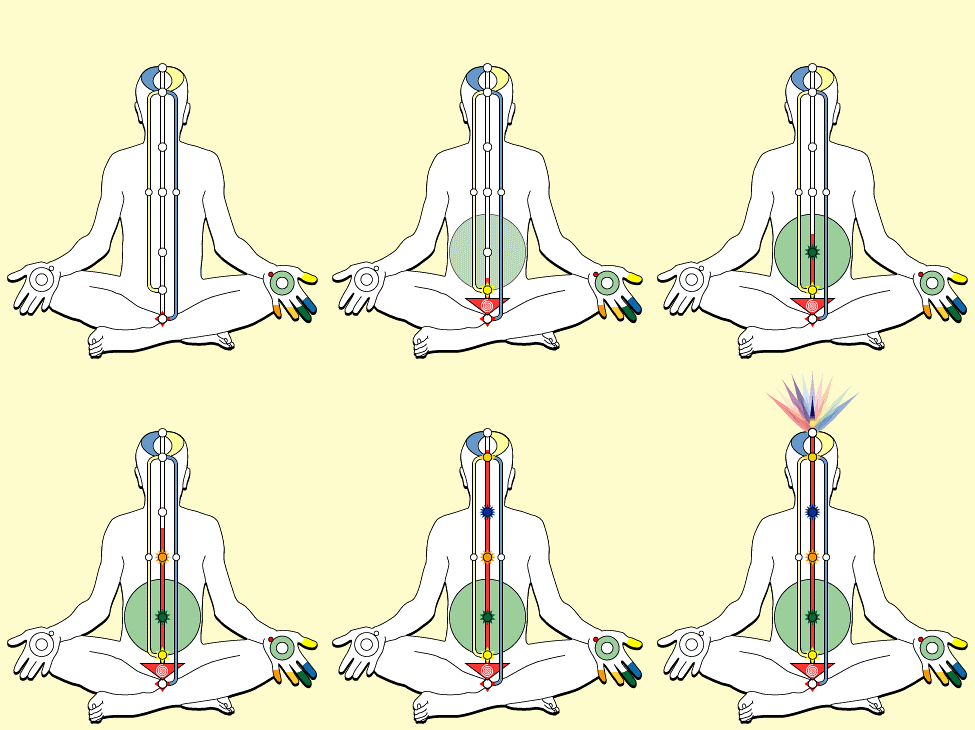
The Kundalini is the primordial power and is reflected in you. In a human being, it is like many strands of energy, like rope. This energy is all twisted together to form that Kundalini. In a human being the strands are 3 x 7 = 21 Nadis raised to the power of 108. When your kundalini rises, one or two strands out of this come up and pierce the fontanelle bone. It has to pass through the innermost nadi known as Brahma Nadi. It is a spiral movement throughout. The kundalini is spiral and nadis are also like a spiral. The outermost nadi is the right-side nadi, Pingala Nadi. The second innermost is Ida Nadi. She starts sending these threads through Brahma Nadi; by that they relax the centre. By relaxing of centre, the sympathetic nervous system also starts relaxing, your pupils start dilating and when it has pierced the Agnya, then the eyes will be completely dilated and shining. Then She enters into Sahasrara.

It is absolutely the pure light of knowledge of love, compassion and attention. All these things are in that energy. We know of many energies like electrical, light energy etc. These energies cannot think. They cannot adjust and work on their own. They have to be handled by us. But this energy itself is the living energy and knows how to handle itself. It thinks. If you see a seed being sprouted you will find at the tip of the seed there is a small little cell which knows how to go around the soft places, how to encircle the stones, and how to find its way towards the source. That cell has got a little Kundalini in it. But within you a tremendous force of Kundalini exists. When a realised soul says that he should have more compassion, as my compassion is not alright; my concern about others, my generosity is not alright, I have exploited other's love. Then this energy starts moving, giving you that greater dimension of love and compassion. If you do not want to grow in your awareness then She does not supply the energy which is stored in you.

The Kundalini is there to nourish you, look after you, and make you grow by giving you a higher, wider and deeper personality. All her power is nothing but love. She gives the power to forgive. Even when you think, the energy for thinking comes from Kundalini because you are asking her help.

The power of Kundalini is absolute purity, auspiciousness, holiness, chastity, self-respect, pure love, detachment, concern, enlightened attention to give you Joy. As a mother will try whatever is possible to give joy to her child, in the same way, this Kundalini has only one power and that is how to give Joy to her own Children. When we talk in the light of Kundalini, we have to understand that this light spreads in your life, outside your life and, expresses itself in a very beautiful manner.

When you worship Adi Kundalini, the reflection in you, which is your Kundalini, is very happy. Also the deities feel happy.

The power of Kundalini which is your own Mother has to rise and manifest itself, because of your Pure Desire. In your introspection, pujas, and in your Meditation, you should see for yourself why are you in meditation. It is for pure desire of compassion and love to be awakened within us. The growth has started and you will find that this shell which is human conditioning and ego will just break open. It is in the triangular bone, which comes up, manifests and can save the whole world. Just see the magnificence, the expansion, the greatness of this Kundalini which was within you and which came up in its full strength and has shown tremendous things.

The joy we feel during music recitals is because Kundalini is dancing. She gets happy because you ask for nothing but enjoyment of collectivity.

You are yourself fully connected when you are absolutely detached and your Kundalini is dancing. You are alone and never alone. This oneness with the whole gives you all the security and joy you want. That's why the Kundalini awakening means collectivity. Unless and until you want pure collectivity in your being Kundalini won't rise.

When you worship Adi Kundalini, you are trying to cleanse your Kundalini, as well and please the deities. This is an object. It cannot be changed. But the reflector can change. The movement of Kundalini depends on temperament of person. Kundalini can give you honesty, and faith in honesty by actualising the experience. Supposing you want to go to a garden and you are suddenly there. Then you will know that your desire is pure and it has worked out. All such miracles happen. The pure desire works out because it is powerful.

When it works, the whole thing works out and you develop faith. That faith is within you. Nobody can challenge you if you have faith. It will be done. Your pure desire is now being fulfilled, you are now connected, and you are now Divine. You are realised souls. You are different from others. For you, all this subtle knowledge is being absorbed, because your Kundalini is absorbing it. Whatever is absorbed is absorbed back by me. But that becomes like a barometer. You immediately know without thinking, asking, you know about anyone because Kundalini is the reflector. The better a reflector, you become, the more the Kundalini shows. Though Kundalini is an individual Mother, in her functions and methods She is just the same. You cannot cheat the Kundalini; She knows you out and out. We must meditate to get into thoughtless awareness by which we allow the Kundalini to grow."

The Paraclete Shri Mataji
Philadelphia, USA — Oct 15, 1993


Kundalini: The dormant, divine Evolutionary Force that enlightens and bestows immortality when activated
"What is Kundalini Really? More commonly known in western cultures as Holy Spirit, Kundalini is the ancient Sanskrit name for the primal life force that animates all living entities—the evolutionary force behind all living matter.... Shaktipat is a Sanskrit word for the process of activating the higher Kundalini-Shakti energy, initiating the process of spiritual growth and enlightenment and advancing personal evolution dramatically. This has also been called the "baptism by fire" and "second birth"—a truly sacred mystical experience.” Dr. Larry Jensen PhD, DD, MBA.

According to Indian tradition, man has seven chakras (centres of energy). The Kundalini force is said to be sleeping, coiled like a serpent, in the lowest chakra, called the root chakra. When this force is awaken, it begins to rise up through the spine. The awakening occurs through yoga, meditation, breathing exercises etc., and was called "the shorter way to God".

The most ancient Eastern spiritual texts, the Vedas, of India, tell us that the process of spiritual awakening by which one attains truth -awareness is called 'Self-Realization'. The Self Realized person lives in direct experience of reality—this is called "Jnana" ( a traditional sanskrit word meaning 'knowledge' or 'Gnosis'). Such a person is called a "Jnani" ('knower ' or 'gnostic' ) or "dwijaha" ('twice born'; first from a human mother to the earthly plane then secondly as a child of the Goddess, or Divine Mother, who gives the seeker their second, spiritual birth, Self-Realisation, into the plane of mystic awareness- gnosis! ).
Kundalini means ‘coiled energy’ and it refers to a power which lies in three-and-a-half coils in the sacrum bone called the Mooladhara which is distinct from, and lies above, the Mooladhara Chakra. (It is interesting to note that sacrum if Greek for sacred.) A pulsation is sometimes seen at this level during Kundalini Awakening. Like the Sushumna, the Kundalini is normally in a potential state. When it is awakened it ascends through the Sushumna, across the void to the top of the Sushumna. When the Kundalini emerges at this point, Yoga is said to have taken place. Yoga is impossible without Kundalini Awakening.
This happening of Kundalini awakening and ultimate union with a higher consciousness are described by a Sanskrit word ‘Sahaja’. This means literally ‘born with,’ spontaneous or effortless. The implication is that the entire mechanism is inborn — part of human anatomy — and is activated in a spontaneous and natural way without undue or extreme efforts. One analogy often used is the germinating of a seed. This happens automatically when the seed is placed in the Mother Earth.
When the Kundalini reaches the Agnya Chakra, one becomes silent and peaceful. The person sits with his eyes closed, so this is not a state of hypnosis, brainwashing or manipulation — just silence. The person is fully aware of himself and of his surroundings and is he wishes to, he can think. However, the person is very relaxed and his attention is not constantly being distracted by the normal flow of mundane thoughts. This state is not achieved by any effort of will or by any mental exercises on the part of the patient. It occurs spontaneously when a Sahaja Yogi, that is to say someone who has the state of Yoga and the expertise of the mechanism, awakens the Kundalini. But this is also an illusion as it the Divine Presence within that gives Self-Realization.
If one of the Chakras is damaged or defective, the Kundalini may be obstructed at that level. In such cases, it is often possible to see the pulsation of the Kundalini at that level with the naked eye, and to hear it with a stethoscope. This pulsation can also be heard at the fontanel and Adi Shankaracaraya called this 'spandakarika.'
As the Kundalini rises through the Agnya Chakra, it cools down the system, especially the cerebo-spinal fluid. This results in the balloons of the left and right Agnya becoming progressively deflated. Once this happens the Kundalini is able to reach the top of the Sushumna; the Sahasrara Chakra. At this point we can say that Yoga has taken place. The person feels the coolness, like a breeze of cool vibrations flowing in the fingers and palms of both hands. The sensations on the hands can, with very little practice, be used to ascertain the state of the Chakras. The nadis and the Chakras themselves begin to manifest in the conscious awareness, and what has so far been a hypothesis becomes part of one’s everyday sensory experience. Our fingertips, the base and center of the palm become extremely sensitive as the sympathetic nerve endings representing the different Chakras become enlightened. (According to the Prashna Upanishad, verse 3:6, there are precisely 727,210,201 nerves.) We can feel on our fingers our own selves and other people by a proper method of decoding, which can be taught to anyone who reaches this stage, in a month. Thus, the diagnosis takes place at a deeper level of our being through our sensitivity to these seven centres.
If one learns how to nourish the Chakras through the knowledge of Sahaja Yoga, one can cure the exhausted Chakras. Thus the patient is cured at the root of the disease. It is a scientific and logical method that exists naturally within ourselves, which gives us a balance, redeems us of our mental and physical troubles, comforts and counsels us.
PRAYER TO MOTHER KUNDALINI

Wake up Mother Kundalini.
Thou whose nature is Bliss Eternal—The Bliss of Brahman.
Thou dwelling like a serpent asleep at the lotus of Muladhara,
Sore, affected and distressed am I in body and mind,
Do thou bless me and leave thy place at the basic lotus.
Consort of Siva the Self-caused Lord of Universe,
Do thou take thy upward course through the central canal.
Leaving behind Svadhishthana, Manipuraka, Anahata, Vishuddha, and Ajna.
Be thou united with Siva, thy Lord the God.
At Sahasrara—the thousand-petalled-lotus in the brain.
Sport there freely, O Mother, Giver of Bliss Supreme.
Mother, who is Existence, Knowledge, Bliss Absolute.
Wake up, Mother Kundalini! Wake up.

KUNDALINI

The word Kundalini is a familiar one to all students of Yoga, as it is well known as the power, in the form of a coiled serpent, residing in Muladhara Chakra, the first of the seven Chakras, the other six being Svadhishthana, Manipuraka, Anahata, Visuddha, Ajna and Sahasrara, in order.

All Sadhanas in the form of Japa, meditation, Kirtan and prayer as well as all development of virtues, and observance of austerities like truth, non-violence and continence are at best calculated only to awaken this serpent-power and make it to pass through all the succeeding Chakras beginning from Svadhishthana to Sahasrara, the latter otherwise called as the thousand-petalled lotus, the seat of Sadasiva or the Parabrahman or the Absolute separated from whom the Kundalini or the Shakti lies at the Muladhara, and to unite with whom the Kundalini passes through all the Chakras, as explained above, conferring liberation on the aspirant who assiduously practises Yoga or the technique of uniting her with her Lord and gets success also in his effort.

In worldly-minded people, given to enjoyment of sensual and sexual pleasures, this Kundalini power is sleeping because of the absence of any stimulus in the form of spiritual practices, as the power generated through such practices alone awakens that serpent-power, and not any other power derived through the possession of worldly riches and affluence. When the aspirant seriously practises all the disciplines as enjoined in the Shastras, and as instructed by the preceptor, in whom the Kundalini would have already been awakened and reached its abode or Sadasiva, acquiring which blessed achievement alone a person becomes entitled to act as a Guru or spiritual preceptor, guiding and helping others also to achieve the same end, the veils or layers enmeshing Kundalini begin to be cleared and finally are torn asunder and the serpent-power is pushed or driven, as it were upwards.

Supersensual visions appear before the mental eye of the aspirant, new worlds with indescribable wonders and charms unfold themselves before the Yogi, planes after planes reveal their existence and grandeur to the practitioner and the Yogi gets divine knowledge, power and bliss, in increasing degrees, when Kundalini passes through Chakra after Chakra, making them to bloom in all their glory which before the touch of Kundalini, do not give out their powers, emanating their divine light and fragrance and reveal the divine secrets and phenomena, which lie concealed from the eyes of worldly- minded people who would refuse to believe of their existence even.

When the Kundalini ascends one Chakra or Yogic centre, the Yogi also ascends one step or rung upward in the Yogic ladder; one more page, the next page, he reads in the divine book; the more the Kundalini travels upwards, the Yogi also advances towards the goal or spiritual perfection in relation to it. When the Kundalini reaches the sixth centre or the Ajna Chakra, the Yogi gets the vision of Personal God or Saguna Brahman, and when the serpent-power reaches the last, the top centre, or Sahasrara Chakra, or the Thousand-petalled lotus, the Yogi loses his individuality in the ocean of Sat-Chit-Ananda or the Existence-Knowledge-Bliss Absolute and becomes one with the Lord or Supreme Soul. He is no longer an ordinary man, not even a simple Yogi, but a fully illumined sage, having conquered the eternal and unlimited divine kingdom, a hero having won the battle against illusion, a Mukta or liberated one having crossed the ocean of ignorance or the transmigratory existence, and a superman having the authority and capacity to save the other struggling souls of the relative world. Scriptures hail him most, in the maximum possible glorifying way, and his achievement. Celestial beings envy him, not excluding the Trinity even, viz., Brahma, Vishnu and Siva.

Kundalini And Tantrik Sadhana

Kundalini Yoga actually belongs to Tantrik Sadhana, which gives a detailed description about this serpent-power and the Chakras, as mentioned above. Mother Divine, the active aspect of the Existence- Knowledge-Bliss Absolute, resides in the body of men and women in the form of Kundalini, and the entire Tantrik Sadhana aims at awakening Her, and making Her to unite with the Lord, Sadasiva, in the Sahasrara, as described in the beginning in detail. Methods adopted to achieve this end in Tantrik Sadhana are Japa of the name of the Mother, prayer and various rituals.

Kundalini And Vedanta

But when we come to Vedanta, there is no question about Kundalini or any type of mystical and mechanical methods. It is all enquiry and philosophical speculation. According to Vedanta the only thing to be destroyed is ignorance about one's real nature, and this ignorance cannot be destroyed either by study, or by Pranayama, or by work, or by any amount of physical twisting and torturing, but only by knowing one's real nature, which is Sat-Chit-Ananda or Existence-Knowledge- Bliss. Man is divine, free and one with the Supreme Spirit always, which he forgets and identifies himself with matter, which itself is an illusory appearance and a superimposition on the spirit. Liberation is freedom from ignorance and the aspirant is advised to constantly dissociate himself from all limitations and identify himself with the all-pervading, non-dual, blissful, peaceful, homogeneous spirit or Brahman. When meditation becomes intensified, in the ocean of Existence or rather the individuality is blotted or blown out completely. Just as a drop of water let on a frying pan is immediately sucked and vanishes from cognition, the individual consciousness is sucked in by the Universal Consciousness and is absorbed in it. According to Vedanta there cannot be real liberation in a state of multiplicity, and the state of complete Oneness is the goal to be aspired for, towards which alone the entire creation is slowly moving on.

The Mysterious Kundalini

Manastvam Vyoma tvam Marudasi Marutsarathirasi,
Tvamapastvam Bhumistvayi parinatayam nahi param,
Tvameva Svatmanam parinamayitum visvavapusha
Chidanandakaram haramahishi-bhavena bibhrushe.
"O Devi! Thou art the mind, the sky, the air, the fire, the water, and the earth. Nothing is outside Thee on Thy transformation. Thou hast become Siva's consecrated queen to alter Thy own blissful conscious Form in the shape of the world".

Kundalini, the serpent power or mystic fire, is the primordial energy or Sakti that lies dormant or sleeping in the Muladhara Chakra, the centre of the body. It is called the serpentine or annular power on account of serpentine form. It is an electric fiery occult power, the great pristine force which underlies all organic and inorganic matter.

Kundalini is the cosmic power in individual bodies. It is not a material force like electricity, magnetism, centripetal or centrifugal force. It is a spiritual potential Sakti or cosmic power. In reality it has no form. The Sthula Buddhi and mind have to follow a particular form in the beginning stage. From this gross form, one can easily, understand the subtle formless Kundalini. Prana, Ahamkara, Buddhi, Indriyas, mind, five gross elements, nerves are all the products of Kundalini.

It is the coiled-up, sleeping Divine Sakti that lies dormant in all beings. You have seen in the Muladhara Chakra that there is Svayambhu Linga. The head of the Linga is the space where Sushumna Nadi is attached to the Kanda. This mysterious Kundalini lies face downwards at the mouth of Sushumna Nadi on the head of Svayambhu Linga. It has three and a half coils like a serpent. When it is awakened, it makes a hissing sound like that of a serpent beaten with a stick, and proceeds to the other Chakra through the Brahma Nadi, which is also called Chitra Nadi within Sushumna. Hence Kundalini is also called Bhujangini, serpent power. The three coils represent the three Gunas of Prakriti: Sattva, Rajas and Tamas, and the half represents the Vikritis, the modification of Prakriti.

Kundalini is the Goddess of speech and is praised by all. She Herself, when awakened by the Yogin, achieves for him the illumination. It is She who gives Mukti and Jnana for She is Herself that. She is also called Sarasvati, as She is the form of Sabda Brahman. She is the source of all Knowledge and Bliss. She is pure consciousness itself. She is Brahman. She is Prana Sakti, the Supreme Force, the Mother of Prana, Agni, Bindu, and Nada. It is by this Sakti that the world exists. Creation, preservation and dissolution are in Her. Only by her Sakti the world is kept up. It is through Her Sakti on subtle Prana, Nada is produced. While you utter a continuous sound or chant Dirgha Pranava ! (OM), you will distinctly feel that the real vibration starts from the Muladhara Chakra. Through the vibration of this Nada, all the parts of the body function. She maintains the individual soul through the subtle Prana. In every kind of Sadhana the Goddess Kundalini is the object of worship in some form or the other.[1]

Description of Kundalini

On the morning of November 18, 1996, at about 7:35 a.m. the father was asking Kash about his unique dream of Shri Mataji and putting the information into the computer. Kash's younger six-year-old son Arwinder, who was meditating nearby, suddenly opened his eyes and told his father that something yellowish had moved like a snake from his Mooladhara Chakra right up to the top of his head. He explained with hand gestures how it had snaked its way up, and was sure that it was in the form of a snake. Arwinder added that it was also very powerful as a flash of white lightning came out of his eyes when it reached the Sahasrara! He also added that he also saw different colors — red, yellow, green, blue — like "rainbow colors," one after another. (Probably he saw the different colors of the chakras.)
When Arwinder first told that he saw "something yellowish moving like a snake" he was questioned a few times to confirm the color as the father had not read or heard from any source the actual color of the kundalini. The quote below is from the book Kundalini Tantra, which was borrowed from a graduate of the Bihar School of Yoga (Yogi Alok Kumar Gupta) on January 1, 1997 i.e., after the above incident. Subsequently more information was obtained that confirmed Arwinder's description of the Kundalini.
"In the traditional descriptions of kundalini awakening, it is said the kundalini resides in Mooladhara in the form of a coiled snake and when the snake awakens it uncoils and shoots up through Sushumna (the psychic passage in the center of the spinal cord), opening the other chakras as it goes. (See Sir John Woodroffe's The Serpent Power.) Brahmachari Swami Vyasdev, in his book Science of the Soul, describes the awakening of kundalini in the following way: "Sadhakas have seen the Sushumna in the form of a luminous rod or pillar, a golden yellow snake, or sometimes as a shining black snake about ten inches long with blood red eyes like smoldering charcoal, the front part of the tongue vibrating and shining like lightning, ascending the spinal column."

Swami S. Saraswati, Kundalini Tantra, Bihar School of Yoga, 1984, p. 10